Unpaid super and director liability: what every company director needs to know
Unpaid Super, Director Penalty Notices and Bankruptcy: What Directors Need to Know
For many company directors, unpaid superannuation can feel like just another business debt sitting in the background.
It is not.
In reality, unpaid super is one of the most dangerous debts a director can face because, in the wrong circumstances, it can shift from being a company problem to a personal one. Once that happens, the consequences can be serious, including personal liability and, in some cases, bankruptcy.
If you are a director of a struggling business, understanding how unpaid super works could make a major difference to your options and your personal risk.
Who actually owes the unpaid super?
At the start, unpaid superannuation is a debt owed by the company, not the director personally. That is an important distinction.
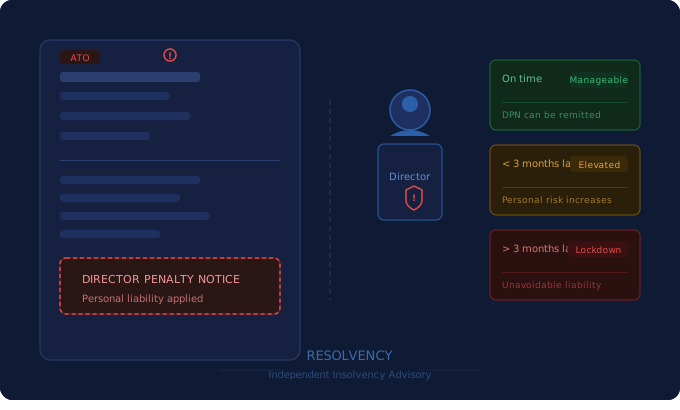
However, that can change if the Australian Taxation Office issues a Director Penalty Notice, commonly called a DPN. Once that happens, directors can become personally liable for unpaid super and PAYG withholding amounts.
This is where many directors get caught out. They assume the company structure protects them completely, but unpaid super is one of the main areas where that protection can break down.
What is a Director Penalty Notice?
A Director Penalty Notice is a formal notice from the ATO that makes a director personally liable for certain unpaid tax obligations, including Super Guarantee Charge (SGC) and PAYG withholding.
In simple terms, once a DPN is issued, the debt may no longer sit only with the company. It can follow the director personally.
That means a director may become personally responsible for debts they previously thought were limited to the business.
What happens if the director becomes bankrupt?
This depends on whether a DPN has been issued.
If there is a DPN, the unpaid super debt becomes a personal debt. If the director then enters bankruptcy, that debt is included in the bankruptcy and managed by the trustee. It is usually cleared only when the bankruptcy ends and the director is discharged, not straight away.
If there is no DPN, the debt remains with the company. In that case, the director is generally not personally liable for the unpaid super.
That difference is massive. It can completely change a director’s exposure and the advice they need.
The biggest risk: Lockdown DPNs
Not all DPNs are equal.
If BAS or Super Guarantee Charge lodgements are more than three months late, the DPN can become a Lockdown DPN. This is the high-risk scenario directors need to understand.
With a Lockdown DPN:
the liability cannot be avoided
liquidation will not remove the director’s personal exposure
the debt follows the director personally
This is why timing matters so much. Directors who act early may have more options. Directors who delay can find those options disappear quickly.
Does liquidation solve the problem?
Many directors assume that placing a company into liquidation will wipe out unpaid super exposure.
That is not always true.
If lodgements have been made on time, or at least within the relevant timeframes, there may still be ways to manage the position. But if the lodgements are more than three months late and a Lockdown DPN applies, liquidation will not remove personal liability.
In other words, once the matter crosses that line, the problem can stay with the director long after the company is gone.
What about employees?
When a business fails, employees may be able to claim certain unpaid entitlements under the Fair Entitlements Guarantee (FEG), such as wages, leave and redundancy. However, unpaid super is not covered by FEG.
That makes unpaid super even more sensitive. It is not only a compliance issue. It can have real consequences for employees and serious legal and financial consequences for directors.
Does bankruptcy end the director’s responsibility?
Bankruptcy can eventually deal with personal liability for debts captured by a DPN, but not instantly.
During bankruptcy, the debt is handled by the trustee. The responsibility is generally only cleared once the bankruptcy process is completed and the individual is discharged.
So while bankruptcy may provide an eventual outcome, it is not a quick fix and should never be viewed as an easy escape route.
Why early action matters
The key takeaway is simple: timing is everything.
Unpaid super can start as a company debt, but if action is delayed and the ATO issues a DPN, especially a Lockdown DPN, it can become a personal problem for the director. Once that happens, the options narrow significantly.
Early advice can help directors understand:
whether personal liability has already arisen
whether a DPN has been issued
whether lodgements are within critical timeframes
what steps may still be available to reduce damage
The longer the delay, the harder it usually becomes to fix.
Final thoughts
Unpaid super is not the sort of debt directors can afford to ignore.
If your business is behind on superannuation, PAYG or lodgements, it is worth getting advice early. A delay of even a few months can be the difference between a manageable business issue and personal liability that follows you into bankruptcy.
When it comes to unpaid super, waiting is rarely the safest option.
